CVOR Requirements in Ontario for New Trucking Companies
Starting a trucking company in Ontario involves more than purchasing a truck and finding customers. New carriers must understand the province’s commercial vehicle safety and registration requirements before beginning operations. One of the most important requirements is the Commercial Vehicle Operator’s Registration (CVOR).
A CVOR is an essential part of operating many commercial vehicles in Ontario. It helps the Ontario Ministry of Transportation (MTO) monitor a carrier’s safety performance, including inspections, collisions, convictions, and other safety-related information.
For anyone planning to start a trucking business, understanding CVOR requirements in Ontario can help avoid compliance issues and create a strong foundation for safe and professional operations.
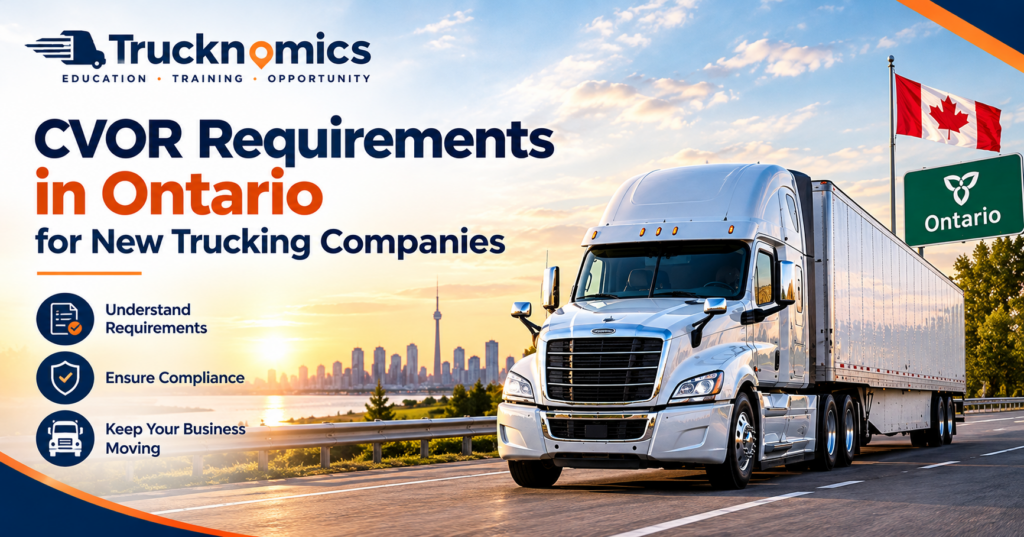
What Is a CVOR?
CVOR stands for Commercial Vehicle Operator’s Registration. It is a registration system used by Ontario to monitor commercial motor vehicle operators and their safety records.
If your trucking operation requires a CVOR, you must obtain a valid certificate before operating the applicable commercial vehicle on Ontario highways. The certificate must also be carried in the vehicle.
The CVOR system tracks information such as:
- Fleet size
- Kilometres travelled
- Commercial vehicle inspections
- Reportable collisions
- Convictions
- Violation rates
- Carrier safety rating
- MTO interventions and audits
This means that getting a CVOR is not simply a registration step. Maintaining a good safety record is an ongoing responsibility for a trucking company.
Who Needs a CVOR in Ontario?
Generally, a CVOR is required for commercial vehicles operating in Ontario that meet the applicable requirements.
According to the Ontario government, a CVOR is required for trucks with a registered gross weight or actual weight over 4,500 kg, as well as certain buses, tow trucks, concrete pumps, and mobile cranes.
For a new trucking company, this is particularly important when deciding what type of truck and operation you will use.
Some vehicles are exempt from CVOR requirements, including certain smaller trucks and vehicles plated in another Canadian province or territory under the applicable rules.
Because requirements can depend on the vehicle, weight, registration, and operation, new carriers should confirm their specific situation before beginning operations.
Also Read: How to Get a CVOR in Ontario: Step-by-Step Guide
CVOR Requirements for a New Trucking Company
If you are starting a new trucking company in Ontario, the CVOR application process requires business and operator information.
1. Determine Your Business Structure
Ontario provides different CVOR application options depending on how your business is structured.
You may apply as an individual, such as a sole proprietor, or as a corporation using the legal corporate name. Corporate applicants must provide information about their corporate officers and applicable incorporation documents.
Before applying, make sure your legal business information is accurate and consistent with your supporting documents.
2. Prepare Your Supporting Documents
New applicants need to provide information based on their business structure.
For a corporation, this can include:
- Corporate incorporation documents
- Information about corporate officers
- Driver’s licence or identification information
- Consent and Authorization form
- Estimated fleet size
- Information about the type of trucking operation
Preparing these documents before starting the application can make the process easier.
3. Submit the CVOR Application
New operators can apply for a CVOR online in eligible circumstances or submit the appropriate application by mail or fax.
The current Ontario government fee for a new CVOR certificate is $287, including the processing and learning/assessment fees.
Applicants should make sure they select the correct application type because fees are non-refundable if the application is submitted incorrectly.
CVOR Learning and Assessment
One important change for new applicants is the CVOR learning and assessment requirement.
As of November 1, 2024, Ontario replaced the previous in-person knowledge test at DriveTest centres with an online CVOR learning and assessment process. New Ontario-based applicants must complete the required learning and assessment before receiving their certificate.
After applying, eligible applicants receive instructions for registering for the online course.
The applicant has six months to complete and pass the learning and assessment. If the requirement is not completed within that period, the application process must be restarted and the applicable fees paid again.
What Happens After You Receive Your CVOR?
Once your CVOR requirements have been completed and the certificate is issued, you must keep a copy of the certificate in each commercial motor vehicle operating under that CVOR.
However, receiving the CVOR is only the beginning.
A trucking company must continue to meet Ontario’s commercial vehicle safety requirements. Operators are responsible for areas such as:
- Driver qualifications and training
- Hours-of-service records
- Vehicle inspections
- Maintenance and repairs
- Cargo securement
- Weights and dimensions
- Dangerous goods requirements
- Driver safety performance
- Accurate fleet and kilometre records
Good recordkeeping is especially important for a new carrier because safety performance can affect the company’s CVOR record and safety rating.
Understanding Ontario CVOR Safety Ratings
Ontario assigns operators a safety rating based on their safety performance.
The four ratings are:
- Excellent
- Satisfactory
- Conditional
- Unsatisfactory
A carrier’s safety rating is publicly available and can affect its ability to operate and attract customers. Serious safety-performance problems can lead to MTO interventions, including audits, fleet limitations, plate seizure, or suspension/cancellation of operating privileges.
For a new trucking company, building good safety practices from the beginning is therefore extremely important.
Hours of Service and Driver Compliance
CVOR compliance also connects with driver hours-of-service requirements.
Ontario’s commercial vehicle safety requirements include limits on driving and on-duty time. For example, applicable drivers generally cannot drive more than 13 hours in a day and cannot drive after being on duty for 14 hours. Drivers must also meet minimum off-duty requirements and maintain the required records.
New trucking companies should establish clear procedures for monitoring driver hours and maintaining accurate records.
Vehicle Inspection and Maintenance
Keeping trucks safe and properly maintained is another important responsibility of a CVOR operator.
Commercial vehicles must undergo the required inspections, including applicable annual or semi-annual inspections performed through licensed inspection facilities.
A new carrier should establish a maintenance system that tracks:
- Regular servicing
- Safety inspections
- Repairs
- Defects
- Inspection dates
- Maintenance records
Proper documentation can help demonstrate that the company is actively managing vehicle safety.
CVOR Renewal
A CVOR certificate must be renewed to remain valid.
The renewal period depends on the carrier’s safety rating. Operators with Excellent or Satisfactory ratings generally renew every two years, while Satisfactory–Unaudited and Conditional operators renew annually. An Unsatisfactory rating does not receive normal renewal because the certificate may be suspended or cancelled.
New trucking companies should monitor their CVOR expiry date and keep their business information updated with the MTO.
Common CVOR Mistakes New Trucking Companies Should Avoid
Starting a trucking company can be exciting, but overlooking compliance requirements can create serious problems. Some common mistakes include:
- Operating a vehicle that requires a CVOR before obtaining one
- Choosing the wrong CVOR application type
- Providing incomplete corporate information
- Failing to complete the CVOR learning and assessment on time
- Not keeping a copy of the CVOR certificate in the vehicle
- Poor driver-hours documentation
- Missing required vehicle inspections
- Failing to maintain maintenance records
- Ignoring safety violations
- Allowing CVOR information to become outdated
Creating a compliance checklist before putting your first truck on the road can help prevent many of these issues.
CVOR Checklist for New Ontario Trucking Companies
Before starting operations, new carriers should review the following checklist:
Business Setup
- Register your trucking business
- Determine your business structure
- Prepare corporate or identification documents
CVOR
- Determine whether your vehicle requires a CVOR
- Submit the CVOR application
- Pay the applicable fee
- Complete the required learning and assessment
- Receive your CVOR certificate
- Keep a copy in each applicable vehicle
Safety & Compliance
- Hire qualified drivers
- Establish driver training procedures
- Maintain hours-of-service records
- Complete required vehicle inspections
- Maintain maintenance and repair records
- Follow cargo securement requirements
- Monitor weights and dimensions
- Maintain appropriate insurance and documentation
Ongoing Management
- Monitor your safety performance
- Keep CVOR information updated
- Respond to safety issues promptly
- Renew your CVOR before it expires
Start Your Trucking Career with the Right Knowledge
Understanding CVOR requirements in Ontario for new trucking companies is an important first step for anyone entering the transportation industry. A successful trucking business requires more than equipment and customers—it requires knowledge of regulations, safety procedures, dispatching, documentation, and day-to-day transportation operations.
For aspiring trucking professionals and entrepreneurs, proper industry training can make the learning process easier and help build practical knowledge before entering the industry.
Trucknomics provides online training focused on trucking and logistics education, including truck dispatcher training, freight broker training, and transportation industry skills. Learning how trucking operations work can help beginners develop the knowledge and confidence needed to pursue opportunities in the transportation industry.
Frequently Asked Questions
- Do all trucks in Ontario need a CVOR?
No. CVOR requirements depend on the type of vehicle, weight, registration, and operation. For example, Ontario generally requires a CVOR for trucks over 4,500 kg and certain other commercial vehicles. - Can I operate my truck before receiving my CVOR?
If your vehicle requires a CVOR, you should not operate it on Ontario highways until the required certificate has been issued. Ontario law requires the operator of a commercial motor vehicle to hold a valid CVOR certificate. - How long is a CVOR valid?
Renewal frequency depends on the carrier’s safety rating. Excellent and Satisfactory operators generally renew every two years, while some other ratings require annual renewal. - Where can I learn more about CVOR requirements?
New carriers should check the official Ontario government CVOR and commercial vehicle safety resources for the latest requirements before starting operations.