A career in truck dispatching has become one of Canada’s fastest‑growing entry points into logistics. With more than 70% of domestic freight moving by truck, dispatchers play a critical role in keeping freight flowing across provinces and across the border.
If you’re looking for a stable, high‑demand career that doesn’t require a commercial licence or years of schooling, dispatching is one of the most accessible ways to enter the transportation industry. This guide explains exactly how to become a truck dispatcher in Canada, what skills you need, how much you can earn, and why learning by doing is the fastest path to becoming job‑ready.
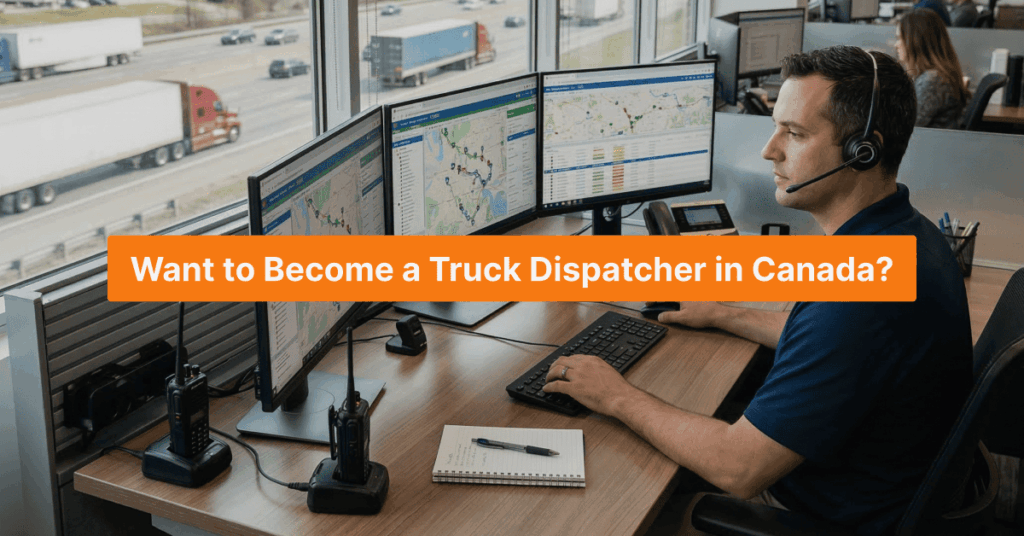
A truck dispatcher coordinates freight movement between drivers, brokers, and shippers. They ensure trucks stay loaded, compliant, and on schedule.
Daily responsibilities include:
Dispatchers use tools like DAT, Truckstop, TMS systems, GPS tracking, and ELD data. Many also manage cross‑border freight, which requires understanding U.S. regulations and border timing. Because these tasks are operational, dispatching is best learned through real practice, not theory alone.
Yes. Job prospects for dispatchers remain moderate to good across most provinces, including Ontario, Alberta, Saskatchewan, and British Columbia.
Demand is rising due to:
Dispatching is a skills‑based career, meaning people with strong communication and problem‑solving abilities often advance quickly, especially those trained through hands‑on, scenario‑based learning.
Dispatcher earnings vary by experience, province, and freight specialization.
National averages:
Entry‑level:
Experienced dispatchers:
Specialized dispatchers—reefer, flatbed, cross‑border, or high‑volume fleets—often earn the highest wages.
Successful dispatchers develop operational thinking and real‑time decision‑making skills.
Key skills include:
These skills grow fastest through learning by doing, not passive lectures.
Understanding freight movement is the foundation of dispatching.
Learn:
Learning‑by‑doing approach: Instead of memorizing terms, analyze real load board listings, compare freight types, and study actual lanes to understand how freight moves.
Professional dispatching includes:
Many beginners struggle because they learn only theory instead of real workflows.
Learning‑by‑doing approach:
Practice building dispatch schedules, negotiating mock loads, and completing real paperwork to mirror the tasks dispatchers perform daily.
Trucknomics Dispatch & Freight Brokerage Training Academy uses a learning‑by‑doing model built on real industry experience.
Students train with:
This approval‑driven method ensures students perform real dispatch tasks, building confidence and competence before entering the workforce.
New dispatchers typically start by:
Confidence grows as you manage more trucks and more complex freight.
Learning‑by‑doing approach:
Students who have already practiced these tasks transition smoothly into real operations because the workflow feels familiar—not overwhelming.
Experienced dispatchers often move into:
Some eventually start their own dispatching businesses, managing multiple carriers and owner‑operators.
At 7:30 AM, a dispatcher logs into the load board. A driver in Windsor has just delivered and needs freight back to Toronto. Within minutes, the dispatcher scans available loads, calls a broker, negotiates a rate, confirms pickup, and sends details to the driver.
Later in the day:
Dispatching is fast‑paced problem‑solving—and that’s why hands‑on training is essential.
Many dispatch courses teach only theory. But real dispatching requires:
Trucknomics was built on the philosophy:
Students learn using real operational scenarios, bridging the gap between training and employment through learning by doing.
1. How long does it take to become a dispatcher in Canada?
Most people become job‑ready in 4–8 weeks with hands‑on training.
2. Do you need a licence to be a dispatcher?
No. Dispatching does not require a commercial driver’s licence or any other licence to work as dispatcher.
3. Can you dispatch from home in Canada?
Yes. Many companies now offer remote or hybrid dispatch roles.
4. Is dispatcher training worth it?
Yes—employers prefer candidates with practical, hands‑on experience.
Canada’s logistics industry continues to grow, and dispatchers remain essential to keeping freight moving efficiently across the country. Becoming a truck dispatcher doesn’t require years of formal education—but it does require practical knowledge of freight operations and dispatch workflow.
With the right hands‑on training, strong communication skills, and real‑world practice, dispatching can open the door to a long‑term, high‑earning career in logistics.
Trucknomics Dispatch & Freight Brokerage Training Academy offers a program built around how dispatching actually works in the real world—because the best way to learn dispatching is to dispatch.


Copyrights 2025. All Rights are Reserved by Trucknomics
Developed by Digify SEO Company
Trucknomics Dispatch and Brokerage
Typically replies within minutes
Hi,
How can I help you?
WhatsApp Us
Online | Privacy policy
WhatsApp us